The Challenge
Regionservice wanted to explore how their services could evolve towards 2050. The challenge was to understand how today's fragmented processes, unclear responsibilities and multiple systems affect both staff and patients, and how a more connected service ecosystem could be designed.
Our task was to identify current pain points and translate them into future-oriented opportunities, while keeping the patient journey at the centre.
The Process
Understanding the current state
We began by mapping the existing service ecosystem through observations, interviews and workshops. This helped us understand how different departments interact and where communication gaps, manual routines and uncertainty occur.
From challenges to needs
We synthesised the research into three important shifts:
- Manual processes to Connected flows
- Unclear responsibilities to Shared understanding
- Multiple systems to Transparency
Looking towards 2050
Through trend research and future exploration, we identified directions that could influence future healthcare services:
- Increased automation and smart logistics
- Connected digital systems and transparent information flows
- More decentralised and flexible service delivery
- Greater patient participation and control
- A stronger focus on sustainable use of resources
The Concept
Regionservice 2050
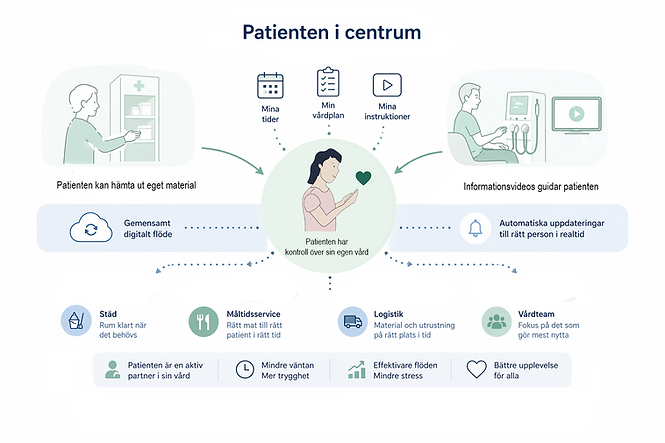
Our concept presents a seamless service ecosystem where people, technology and physical environments are connected throughout the patient journey.
The concept is built around five key principles:
- Digital integration
- Communication
- Automation
- Decentralisation
- The patient as an active participant
A seamless patient journey
We visualised the concept through a storyboard following a future patient journey. It shows how connected services, smart logistics and shared information can support both patients and staff before, during and after a hospital visit.
My Contribution
I participated throughout the project, from field research and analysis to visualisation and concept development. My main contributions included observations, interviews, journey mapping, visual synthesis and storyboarding.
I helped turn complex research material into understandable visual narratives and supported the team in developing the final future concept.
Reflection
This project strengthened my understanding of service design in complex organisations. I learned how research, systems thinking and storytelling can be combined to make future scenarios tangible and easier to discuss.
It also gave me experience collaborating with a public-sector organisation and balancing ambitious future thinking with real needs and constraints.
Project team
Cecilia Johansson · Amanda Eskilsson · Maria Fallström · Rebecka Tärby · Jessika Söderberg · Ratchaneekorn Wimonsuk