Context & Research Question
As a team of four Digital Design and Innovation students, we explored what happens when a non-human actor is invited into a learning environment. Rather than designing an app, we used more-than-human design to question the relationships between people, living materials and the spaces where learning takes place.
Our research question was: How can we reframe participation on campus by giving moss an active role in the learning environment? The target group was students in higher education.
Questioning the Familiar
Our initial research examined assumptions about the “ideal student”: engaged, organised, independent, academically skilled and socially involved, following a linear study path and adapting to university expectations. These assumptions can overlook differences in students’ experiences, circumstances and opportunities.
This raised a broader question: who is expected to participate, and in what ways? Desktop research helped us move beyond a purely human-centred view of learning, considering bodily experiences, the senses, nature and the surrounding environment. It also highlighted that inclusive learning spaces require both deliberate design choices and organisational support.
Moss offered a way to explore this shift. Its uses span historical medicine, architecture, gardens, art and design, while thinking with moss encourages a slower, situated and attentive relationship with our surroundings.
Fieldwork & Listening
We carried out auto-ethnographic observation at Galgberget, paying attention to moss in relation to its forest environment. Colour, texture and moisture drew our attention to sensory experiences, small organisms and connections that are easily overlooked.
In interviews, participation was often associated with speaking, listening and contributing. Moss was described as calming and decorative, but also as unusual in a learning environment. We interpreted this as a sign that human communication easily becomes the measure of participation, while unfamiliar materials can challenge expectations and redirect attention.
Observing moss in its environment
Making the Question Tangible
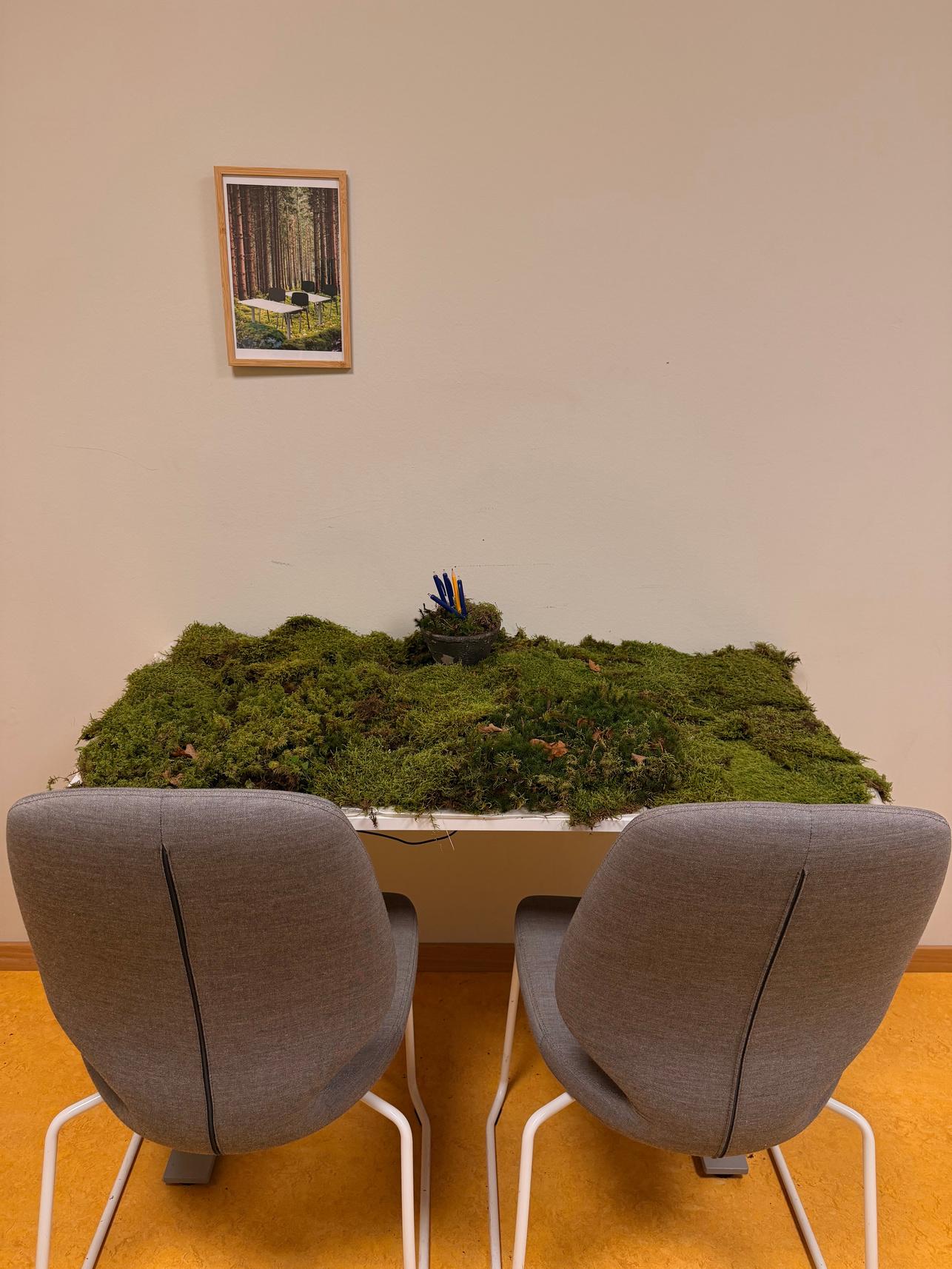
We developed a showroom and a provocative prototype — a “provotype” — to challenge familiar classroom norms. Moss covered a table, while a picture on the wall showed a table in a forest setting.
Participants completed a test, an individual written reflection and a shared spoken reflection. We observed how the material affected posture, sensory experiences and use of the room. The purpose was to make assumptions visible through an encounter, rather than present a finished solution.
Sketching the showroom
The moss table & forest picture
What the Showroom Revealed
- The body adapts. Some participants changed posture or used a wall or their knee as a writing surface. Moss disrupted the expectation of a flat, hard and dry surface, making familiar ways of using the room visible.
- Placement matters. Participants suggested walls, floors, mats or pots. Accepting moss in a room was not the same as accepting it as a work surface.
- Calm meets resistance. The scent was described as calming and forest-like, while dampness and softness made writing difficult. The same material could be appreciated and get in the way.
- Norms are shared. Participants were influenced by one another’s actions and sought functionality, questioning how a traditional classroom should be arranged.
- The picture’s role remains open. It prompted curiosity and ideas about alternative learning environments, but several participants noticed it only after the test. Its connection to the activity needs further exploration.
Showroom observations
From Findings to Design Directions
Our findings suggest a broader understanding of participation as embodied and sensory. Materials do not simply sit in the background: they can change how people experience and use a learning environment.
We proposed exploring moss on walls, floors or in pots where it does not obstruct writing, and investigating how placement affects concentration and sensory experience. People should be able to choose whether and how they interact with its scent, texture and softness, since these qualities can be experienced positively or negatively.
A future table concept combines moss with a glass writing surface, integrated power outlets, LED lighting and irrigation. The sketch explores how a living material could coexist with practical requirements; it is a proposed direction, not a built or tested smart table.
A possible next step
The sketch illustrates a concept for a smart table where moss takes an active role in the environment. The table includes integrated power outlets, LED lighting and an irrigation system to support the moss’s wellbeing. A glass surface sits above the moss, integrating the living material into the table’s functional design.
Reflection & Research Limits
The process demonstrates how literature, field observation, interviews and a tangible provocation can work together to uncover assumptions that are difficult to notice in an ordinary classroom. Mixed reactions were valuable: the tension between sensory appreciation and practical resistance helped us develop more considered design directions.
Importantly, the study documents people’s reactions to moss — it does not establish that moss itself has agency. Participants associated it with calm and nature, but a lasting calming effect would require further investigation. Keeping observations, interpretations and future possibilities distinct was central to how we communicated the research.
Project team
Maria Fallström · Amanda Eskilsson · Rebecka Tärby · Cecilia Johansson
Research foundations
Gregersen & Nielsen, Not quite the ideal student; Tannehill, Andragogy; Gravett, Troubling transition. The poster also draws on writing about sensory learning with moss by Alexandra Crosby, Ilaria Vanni and Jo Paterson Kinniburgh.